Sunday, February 12, 2012

… to Easter Island, Chile …

… also known as Rapa Nui, a Polynesian island 2,237 miles from mainland Chile. The entire island is a Unesco World Heritage Site, one of the world’s most isolated inhabited places. Our biggest challenge was getting ashore after our arrival; six foot swells buffeted the tenders (the ship’s lifeboats) on the way to shore. There is no pier or dock on Easter Island, so the ship’s crew rigged up a landing site with one anchored tender, and a small floating plank dock before stepping ashore. The tenders pulled up to the anchored tender, and passengers stepped from one tender to the next, onto the platform, and then ashore. However, in the swells, the tenders moved independently, and the leap from one to the next had to be well timed to ensure passengers were not injured. In addition, the plank dock bobbed up and down in the waves, making the transfer even more exciting. Late in the afternoon, the original plank dock broke, and a second malfunctioned as hundreds of passengers waited on shore to re-board the ship. The crew was amazing, pitching in to help, and everyone made it back safely. However, two of the lifeboats were damaged, and will be repaired in Sydney.

Easter Island is tiny - only 15.3 miles long by 7.6 miles wide. The large stone statues or moai for which the island is famous were carved from 1100 to 1680 AD according to radio-carbon dating. 887 statues have been inventoried on the island and in museum collections. Although they are often referred to as “Easter Island heads” the statues include complete torsos, with the figures kneeling on bent knees with their hands over their bulging stomachs. The hands have long fingers and fingernails. Some of the statues have been buried up to their necks by shifting soil.

The landing site was a beach with 7 standing moai or fragments, a lone moai, and 3 or 4 moai laying down. The separate red headgear was made to simulate a top-knot; it is believed that the island was ruled by people with red hair.

DSC06279    DSC06285

Easter Island has no real tourism infrastructure; we shopped at a few rudimentary souvenir stands selling small moai and shell jewelry, walked along the beautiful beach, and had a soda at a refreshment stand, whose colorful owner was roasting chicken over lava stones.

DSC06207    DSC06304

An excursion took us to several sites with more moai. At the first stop, 15 standing statues were placed along a lovely beach, facing inland, with a few more moai toppled in the sand.

DSC06390    DSC01776

The island has 3000 inhabitants, and more than 4000 horses, most of them running wild. Horses pose the biggest threat to the moai, using them as back-scratchers, toppling them, and trampling the carefully arranged stone platforms on which the statues stand. 2000 head of cattle are also raised here, along with a few sheep and goats.

DSC06361  

Our favorite stop of the trip was the ancient quarry where the moai were carved. Moai were everywhere! These statues had no eye sockets, because the sockets were carved only when a statue reached its resting place. Each statue is thought to represent a single deceased person, and all originally had eyes. One theory is that the statues were carved at the quarry, gently worked free of the surrounding stone, and moved with ropes and logs carefully down the slope. The statues remaining here may have fallen while being moved. Many are buried up to their necks, but all have bodies beneath the surface.

DSC06449

DSC06430  DSC01779

Our last stop was in Tahai; a line of moai sat on a beach, facing inland as before, with their backs to the ocean. The most interesting moai here has its eyes replaced as they originally were and is the only moai on the island with eyes. 

DSC06599    DSC06606

We drove through the town of Tahia; a jumble of small buildings and houses, it is the only place on the island with electricity and water. All water is brought from this town to the farms and other homes on the island.

And then the tender ride back to the ship. We were very fortunate to get aboard after only a short wait; some passengers waited more than two hours in the heat and humidity before being ferried to the ship. This delay in departure means we will have to do 21 knots an hour in order to reach Tahiti in time, on Thursday morning. Fortunately we will have to spend extra time re-fueling, so our visit to Papeete will last into the evening. Until then, several more relaxing days at sea, where we will gain an hour every night, meaning a very good night’s sleep!

Friday, February 10, 2012

… to Punta Arenas, Chile …

… which calls itself the south-most city in South America – and says Ushuaia is an imposter because although it’s south of Punta Arenas, it’s on an island, so it shouldn’t count! We visited both so it doesn’t really matter. Due to a storm in the Pacific, we had two days in Punta Arenas instead of one. Tendering ashore was rocky, with waves slapping over the windows. Gale force winds whipped around the dock as we left the tender. Inside the port terminal the ship manned a hot chocolate station. Ummm! Our excursion was later so we walked a few blocks to the town square. Punta Arenas has about 125,000 people, and a long history as a stop for ships passing through the Strait of Magellan. The city reached its pinnacle from 1850 until the Panama Canal opened in 1913, and the city crashed. Many mansions built by local tycoons remain, including several on the square, which also has a large statue of Magellan with an indigenous native. Legend has it that if you rub the Indian’s big toe, you will return to Punta Arenas; after posing for a toe-rubbing photo, we re-thought that choice ... as it began sleeting, then hailing, then raining. The square was filled with local vendors selling handicrafts – many woolly and warm!
DSC05786    DSC05785
Our bus excursion took us to a mansion turned museum, the Braun Menendez house.
DSC05736    DSC05659   
Our guide took us downtown on the main street, lined with monuments to sheepherders, oilmen, Croatians, etc. Next stop: the cemetery, similar to Recoleta in Buenos Aires, with ornate mausoleums and incredible mushroom-like cypresses. Here it began pouring in earnest, with no shelter to be had. Soggy, we climbed back on the bus for a stop at a scenic overlook, and then on to the Dick family sheep farm museum.
DSC05815     DSC05887
Here they plied us with fine red Chilean wine, and empanadas. Someone made the mistake of asking what was in the empanadas and it turned out to be llama meat. They just didn’t taste the same after that… We saw a short film, then watched a sheep-shearing demonstration.
 DSC01630      DSC06008
Day two included a visit to the city’s cathedral, shopping for lapis lazuli (abundant in this area), and the best stop of all: at Corsini Café, for a cup of spectacular hot chocolate. Even better, just as we got settled with our steaming mugs , it began hailing and sleeting outside! The sun reappeared as we finished. We stopped at the local supermarket on the way back to the ship for a few bottles of Chilean late harvest dessert wine. The ship arranged a huge Super Bowl Party that night, and a good time was had by all. 
DSC06101     DSC06160

Thursday, February 9, 2012

… to Ushuaia, Argentina …

… which is pronounced “Oo-SHWY-uh,” and markets itself as the southernmost city in South America. With 70,000 people, it is a windswept and chilly place, even in summer.  We were up early to take a bus excursion to Tierra del Fuego – the End of the Earth - making three stops: at Ensenada Zaratiegui, an ocean beach om which we could see Chile across the water; Lago Roca, a large lake; a large Park Information Center with wonderful empanadas – and Fanta; and Bahia (Beach) Lapataia, with a plank boardwalk to the very end of the earth. At one side of the boardwalk beavers are active, and we saw their dams and houses.

DSC05140DSC05261

Heading back to town after the tour, we stopped to shop, and met a wonderful Peruvian jewelry maker who demonstrated how to make the clasps he used for his necklaces, and then gave us a clasp as a sample. Very nice!! Lunch in Ushuaia was an amazing King Crab entrée, a mound of crab meat and peeled legs so large it had to seen to be believed. It was actually listed on the menu as a starter or appetizer portion!

DSC05477

Back on the ship, Frank went to a lecture by the scientists from the US Palmer Antarctic Research Station. A highlight of the evening was Frank’s passing of 5 kidney stones of varying sizes. 

… to Antarctica!

Brrrrrrr … it made us long for warmer weather when we began our Antarctic exploration on Monday, January 30. Early in the morning we passed between Clarence and Elephant Islands, and saw our first “blue ice.” The ice is a lovely shade of bright turquoise blue, which makes it look almost fake. We headed through the Bransfield Strait, and then into Hope Bay, moving through the Antarctic Sound. All of the scenery was peaceful and still, and we saw some large cormorants and other flying birds circling the ship.

DSC05348

The adventure continued the following day. We passed the UK’s Port Lockroy Station early in the morning, then went through the Bismarck Strait to Paradise Harbor, past the Argentinian Brown’s Station, then the Chilean Station, Neko Harbor, Herrera Channel, Gierlach Strait, and finally, Lion Island. Throughout it all we had exceptionally nice weather, sunny, mild, with no wind and beautiful visibility. It was an exceptionally lovely day. We spent much of the day outdoors on the rear deck and the front deck. The ship served hot chocolate and other warm drinks to thaw us out. One thrill was when the Chilean Station scientists saw us, they began waving a huge Chilean flag, standing on the Station roof. Because the Station was completely surrounded and overrun by penguins, it looked as though the humans were surrendering to the penguins, who definitely had superior numbers!

DSC05474DSC05857DSC05418DSC05559DSC05381

Back on the ship, it was yet another formal night, this one for the Blue and Silver Ball. Frank and I decided to eat dinner in the Lido instead, and it was very good.

Monday, January 30, 2012

... to Stanley, Falkland Islands...

... a town of 2500 inhabitants on a windswept, desolate island. After two days of R&R at sea, we were ready for an adventure. We chose an overland expedition to visit the penguin rookery at Bluff Cove. Accessible only by Land Rover, we jolted for half an hour over uneven, rutted terrain, rocks, and gorges to reach the beautiful but secluded Bluff Cove. Home to more than a thousand Gentoo penguins, the rookery also has a small colony of King penguins, who stand head and shoulders above their smaller cousins. One protective King penguin father was warming an egg which was about to hatch. The rookery is watched over by the family who owns the land around the Cove, and makes sure no one bothers the penguins as they grow. The ground was strewn with penguin down from the mostly molting 3 month old chicks, who will go out to sea in the next few months. They were an endearing crowd, waddling up to us to see what we wanted. The innocence of youth! The nearby Sea Cabbage Inn offered fresh hot coffee, tea and chocolate, along with home-baked goodies, very welcome after braving the winds in the cove. Although it was a balmy 65 degree summer day, the wind was icy and relentless. Not good for contact wearers!


After our penguin visit, our driver returned us to Stanley, formerly known as Port Stanley. We had a nice lunch of fish n' chips at Deano's, a local hangout, which fueled us for a walk up Stanley's steep streets to get a better view of the town's colorful roofs. Many houses had lovely vegetable and flower gardens, which must have been quite a feat given the harsh conditions. One family has a display of various types of whale skeletons, and the local church has an arch made out of whalebones. We learned that Prince William will be returning to the island in the next week or two for a new tour of duty. Just missed him!


We enjoyed the walk and the many lovely gift shops along the major street. We were happy to make it back to the ship just before a brief rainstorm. Next up: Antarctica!

I'm again having trouble uploading photos, so will do so as soon as the connections improve. The penguins were adorable!

Thursday, January 26, 2012

... to Montevideo, Uruguay!

Montevideo, the capital and largest city in the relatively small country of Uruguay, is located at the mouth of the Rio de la Plata. This river is huge you can almost not see one shore from the other, and its location makes Montevideo one of the major ports of South America. The majority of the population is Spanish and Italian, and the European influence is evident in the architecture of the city, which is somewhat of an artists' colony with dozens of art and craft galleries. Its also world-famous for its beef.


The port is very close to the center of the old town, not more than a 5 minute walk, so we began the day with a lengthy walk around Old Town. Shops sell all types of handmade items, including many things made of leather, wool, fur, and wood. In addition, vendors often line the pedestrian streets, selling souvenirs and crafts, vying for space with vegetable stands. We greatly enjoyed our walk, and walked further than we intended before going back to the ship to catch our afternoon tour, which was supposed to be a bus tour of the city's architecture. Much to everyone's surprise (including several folks with walkers and canes) it turned out to be a walking tour - which lasted more than 4 hours! It was also, hands-down, the worst tour so far. But the city is delightful, and definitely worth a visit.

... to Buenos Aires!

Two days at sea, capped by a great onboard concert by Doc Severinson and the San Miguel 5 (what a showman and how that man enjoys what he does - at 84 years old!) put us in great shape for 3 back-to-back days in port.


We began our first day in Buenos Aires with an excellent tour which hit all the high spots. A bus ride took us through the port area to the North side of town, home to the financial district and the high end shopping and housing areas. We next went downtown, to the central part of the city, where we disembarked at Plaza de Mayo, to see the "Pink House" - the Presidential palace, with its famous balcony, used by Evita for speeches and by Madonna for a song in the film "Evita. The famous balcony has the 6th, 7th and 8th windows from the left on this photo.


Next we climbed aboard the oldest subway in South America, built in 1913 by the British and still in operation. We rode an original car to the Cafe Tortoni, the city's best-known meeting place. It reminded us of the intellectual coffee houses in Vienna.


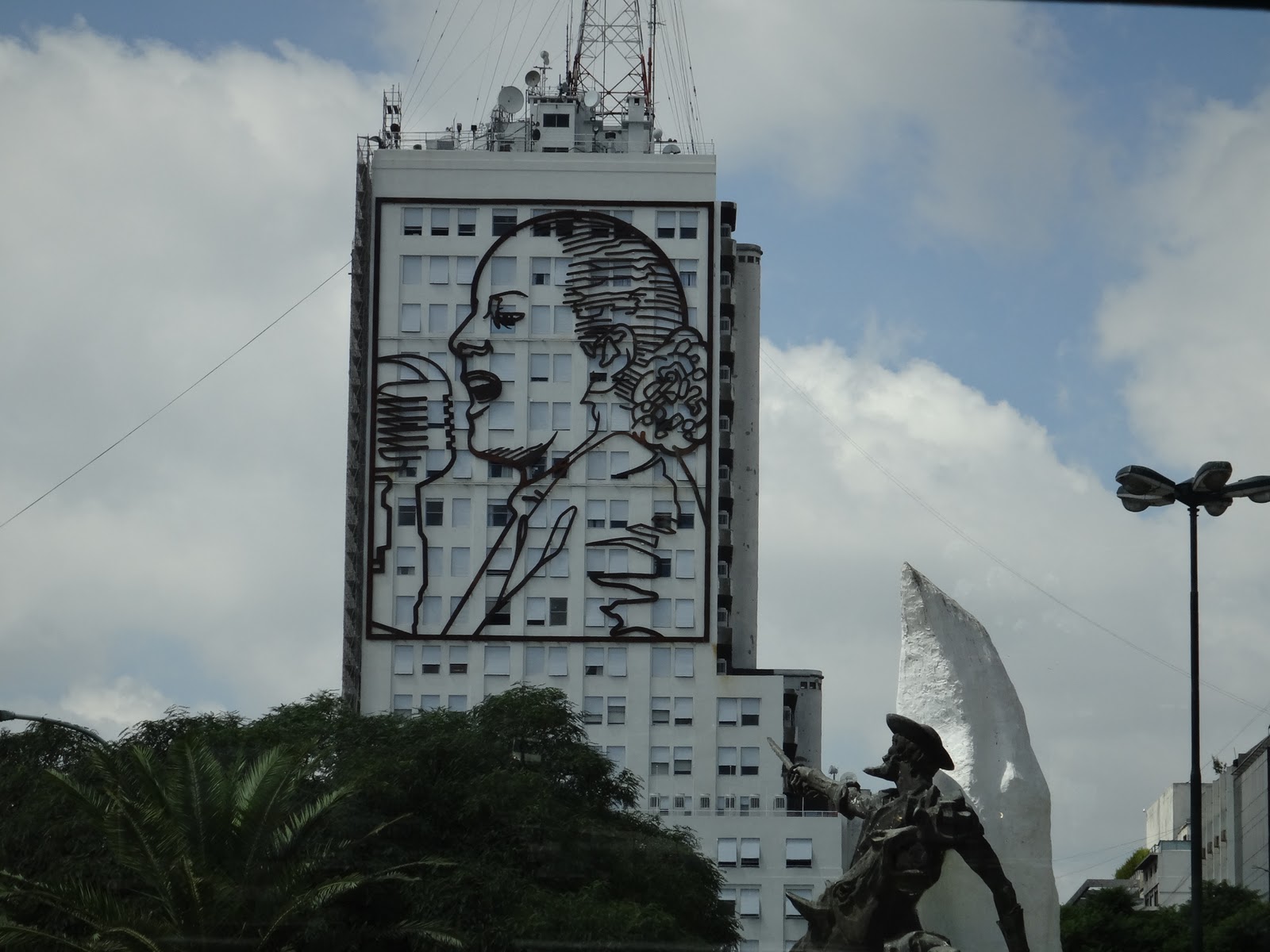
During our tour we crossed the Avenue of the 9th of July, the widest street in the world; we counted at least 16 lanes. Pretty spectacular. A large building features Evita's picture and lights up at night.


We continued by bus to the South side of the city, historic home to the immigrant populations from Europe, and strongly Italian. The many-colored houses of Caminitos supposedly came from the owners requesting paint from ships in port, and using whatever colors were available. The tour concluded with a drive by Madero Port, a port originally built to replace the original port, but which turned out to be unusable for large ships. In an urban renewal project, the city has turned this area into the trendiest spot in town, home to several miles of restaurants, shops, and offices. We walked and shopped Florida Avenue, a pedestrians-only shopping district, home of the Galleria Pacifica, a lovely mall in an old restored building. The second day, we revisited many of these sites with our friends Lee and Troy, who had flown to Iguazu Falls the first day. In Caminitos, Frank had the opportunity to tango!

In addition, we took a cab to La Recoleta Cemetery, filled with spectacular little mausoleums built by famous artists, including 70 which are national monuments. The best-known "resident" is Evita, who rests in a low-key monument with other members of her family (but not Juan Peron, who is on the other side of town).


Buenos Aires is definitely our favorite port so far; there is so much to do and see in this phenomenal place that we are already planning to return.